The Workshop of Fragility, by Marisa Cornejo
Opening: November 12, 7 pm
Venue: HAUS – Space for Art and Contemporary Practices at BAU (Carrer Ciutat de Granada 34–36, Barcelona; Metro: Llacuna)
BAR Project presents El Taller de la Fragilidad (The Workshop of Fragility) by Marisa Cornejo, curated by Andrea Rodríguez Novoa and Veronica Valentini in dialogue with Elise Lammer.
El Taller de la Fragilidad brings together a selection of works created by Marisa Cornejo at different stages of her artistic practice, alongside new works produced in 2026. Through photography, drawings, sculptures, objects and archival materials, the exhibition explores experiences of exile, displacement, memory, belonging and migration.
Cornejo was born in Santiago, Chile, in 1971 and was forced into exile with her family during the military dictatorship. Since then, the experience of exile has permeated her work as a condition that continues to shape her relationship to places, images, bodies, and memories. Her practice also raises questions about what it means to be unable to return to one’s place of origin, how a sense of belonging is constructed when it becomes discontinuous, and the experiences of recognition and non-recognition that shape migratory trajectories.
Photographs and postcards of Chile occupy a central place in the exhibition. During her childhood in exile, Cornejo and her brother Marisa received regular postcards depicting Chilean landscapes from their maternal grandparents, who had returned to the country. Through these images, their grandparents sought to transmit something of their cultural heritage. Cornejo collected and preserved the postcards, treasuring them as a precious inheritance. In 2026, during a trip to Chile, she took a new series of photographs and used them to create a collection of postcards that revisits the graphic and narrative conventions of those she had received from her grandparents. Depicting cities, markets, landscapes, and family encounters, these images bear witness to a renewed relationship with a territory she can now travel through and observe from the vantage point of the present. This research takes material form in Los tótems de nuestra re-existencia, a series of eight plaster sculptures, each bearing one of these Chilean postcards on one of its faces. Images originally conceived to circulate and convey a representation of a place become part of three-dimensional objects that occupy physical space. No longer functioning solely as images of an absent territory, the postcards acquire volume, weight, and presence.
This relationship between image, territory, and object was already explored in Icara (1994), a work made in Mexico using a collection of images of Chilean landscapes. Cornejo transforms the postcards into a female body and into surfaces that can be incorporated into tables and domestic objects. The represented territory thus becomes something physical, everyday, and usable, while the act of turning images into objects offers a way of approaching the experience of exile through its bodily and material dimensions. Icara marks one of the earliest stages in an ongoing investigation into how the fragments of a territory from which she was separated might be given physical form through the archive.
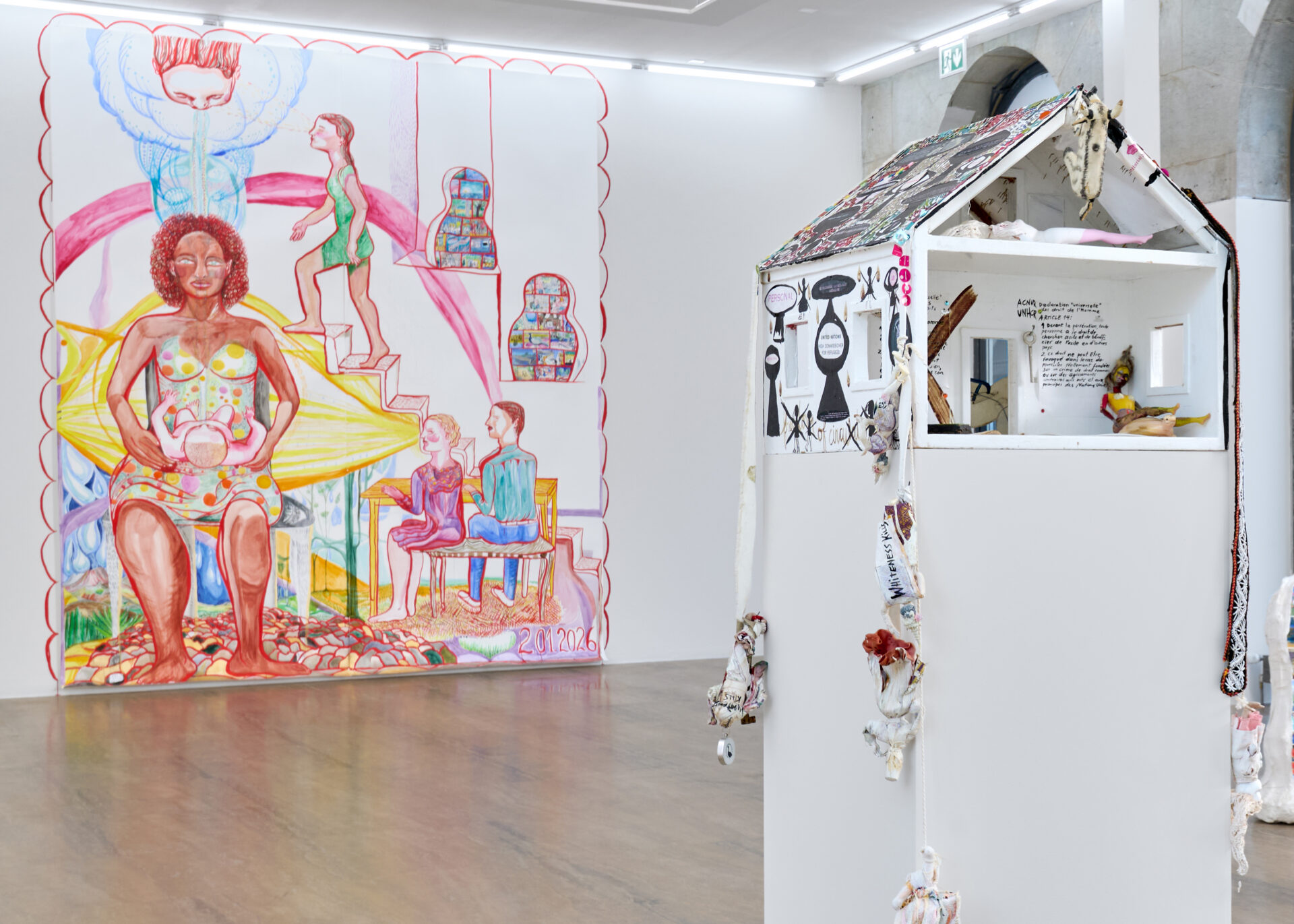
Alongside these works, other objects further develop the exhibition’s reflection on migration, belonging, and recognition. Calidad y condición migratoria (2015–2026), an object made of painted wood and collage, directly addresses the experience of migratory status.
The exhibition also features The Politics of Dreams, a selection of sixteen dream drawings made between 2022 and 2026, many of which are shaped by the figure of the mother. Since 1997, Cornejo has documented her dreams through daily drawing. Bodies, familiar spaces, memories, and situations emerge in these works, moving between the everyday and the imaginary. Dreams become a means of recording and working through experiences that cannot always be organized through linear or conscious recollection.
Among these works is La madre que me enseña a respirar, a large-scale drawing produced during Cornejo’s exhibition at Halle Nord Genève, based on a dream she had during her most recent trip to Chile. It depicts a mestiza woman caring for a baby and helping it breathe; the baby may be the artist herself. The maternal figure thus becomes associated with care, transmission, and learning, while breathing emerges as a fundamental bodily act and, at the same time, a way of reclaiming the capacity to inhabit space. The drawing serves as a key to understanding the exhibition as a whole: in the face of a traumatic experience that can constrict and “flatten” the body and its memories, breathing becomes a means of expanding again and reclaiming space.
The exhibition brings together different temporalities without presenting them as a linear progression. A single image may appear as an archive document, an object, a photograph, or a memory, acquiring new meanings in each context. Rather than reconstructing a linear history of exile, El Taller de la Fragilidad proposes a constellation of images, objects, and memories in which past and present remain in dialogue. Fragility is not presented as a condition to be concealed or overcome, but as a space from which to create, remember, connect, and look again.
The project is a co-production by BAR Project and Halle Nord Genève, with support from Pro Helvetia Swiss Arts Council and the Republic and Canton of Geneva.
Photo credits: ©Thomas Maisonnasse